Aurelia NavBot 9 Self-Empty
LiDAR-mapped cleaning that empties itself for weeks
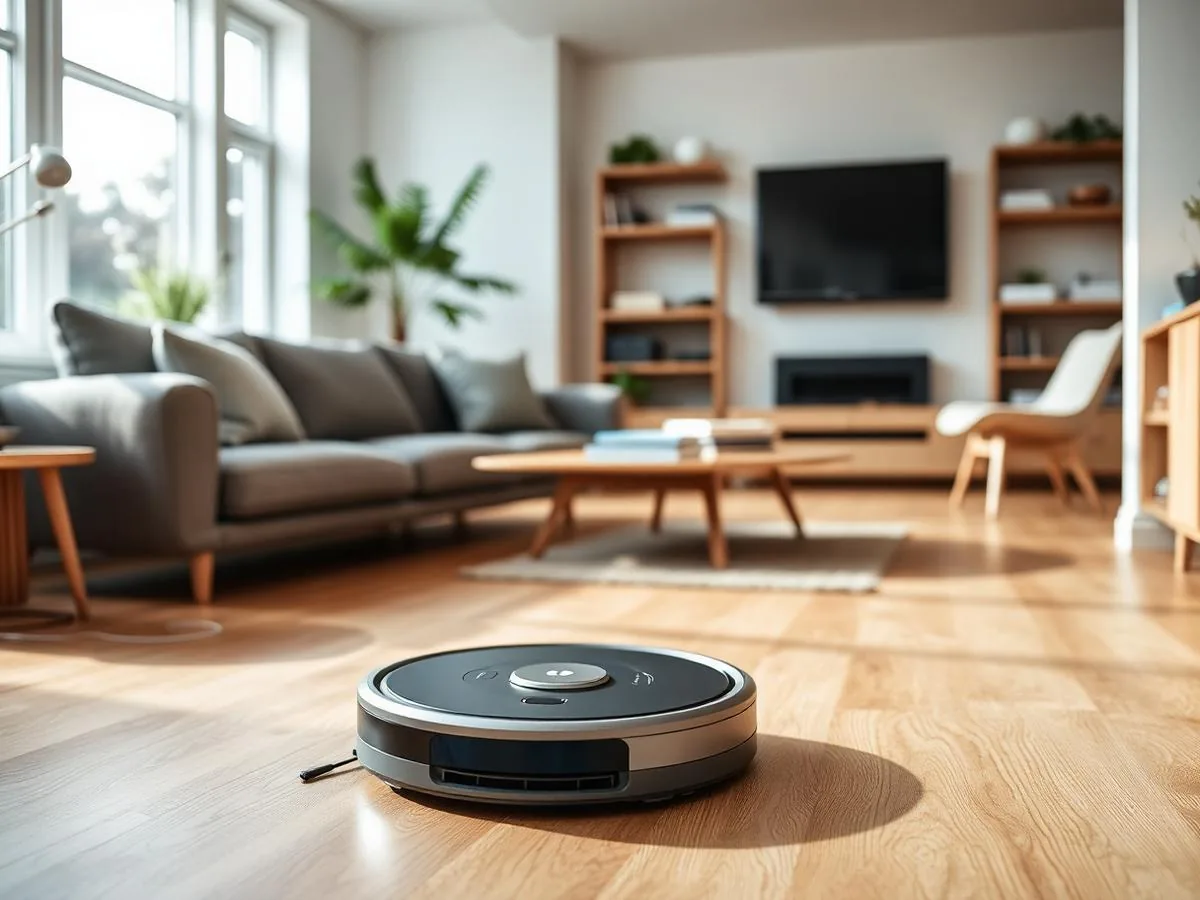
A LiDAR-navigating robot vacuum that maps rooms accurately, avoids cords and pet messes, and empties its own bin for up to 60 days of hands-off cleaning.
$549
Reviewed by Trey Alvarez · Updated July 21, 2026. We may earn a commission when you buy through our links.
Our hands-on verdict
Aurelia built its reputation on mid-range smart home appliances, and the NavBot 9 is its most ambitious robot vacuum yet. It pairs a spinning LiDAR turret with a self-emptying base, targeting buyers who want Roomba-level mapping without the flagship price tag. We ran it for six weeks across a 1,800-square-foot single-story home with hardwood, tile, and mixed-pile rugs.
Setup took about 15 minutes: unbox the base, insert the dust bag, connect to Wi-Fi through the Aurelia Home app, and let it complete an initial mapping run. The LiDAR turret builds a surprisingly precise floor plan on the first pass, correctly identifying room boundaries and letting us draw no-go zones around a dog bowl and a tangle of charging cables before the second run even started.
Suction performance is strong for the price class. On hardwood and tile it lifted embedded debris like coffee grounds and cereal crumbs in a single pass. On medium-pile rugs it needed a second pass roughly a third of the time, and on thick shag it struggled to fully clear pet hair from the base of fibers. The rubber main brush resists hair wrap noticeably better than the bristle brushes we've tested on cheaper models.
The self-emptying base is the headline feature, and it delivers: the bin held six weeks of debris from two shedding dogs before we needed to change the bag, versus the roughly 3-day capacity of the onboard dustbin alone. The base is loud for about 12 seconds during emptying, which is easy to schedule around since cleanings can be timed for when you're not home.
Battery life measured about 110 minutes per charge in our testing, enough to clean the entire main floor in one go on the Standard setting. Mapping accuracy held up well over six weeks with no drift or re-mapping required, and the app's cleaning history logs are detailed enough to spot problem areas, like a hallway rug that consistently needed extra passes.
Aurelia's app also supports voice control through Alexa and Google Assistant, room-specific scheduling, and a decent virtual wall feature using the app map rather than physical strips. Firmware updates during our test period improved obstacle recognition for shoes and cables without us having to do anything.
Pros and cons
What we liked
- Self-emptying base genuinely lasts around 60 days for a two-pet household
- LiDAR mapping is accurate and didn't drift over six weeks of use
- Rubber brush resists pet hair tangles noticeably better than budget models
- App is intuitive with detailed cleaning history and room scheduling
- Strong single-pass suction on hardwood and tile
- Quiet enough to run during a video call on Standard mode
What we didn't
- Struggles to fully clear thick shag rugs in one pass
- Base emptying cycle is loud for about 12 seconds
- Mop function is light-duty and can't handle dried spills
- Replacement bags and brushes add to long-term cost
Features that matter
LiDAR room mapping
A spinning laser turret builds a precise floor plan on the first cleaning run, letting you set no-go zones, room-specific schedules, and cleaning order directly from the app instead of relying on random bump-and-turn navigation.
Self-emptying base
The charging dock automatically vacuums the robot's bin into a sealed bag after every cleaning cycle, holding up to 60 days of debris in average households and dramatically cutting down on maintenance chores.
Rubber main brush
A dual rubber brush design resists hair wrap far better than bristled brushes, which matters most for households with pets or long hair where traditional brush rolls quickly become tangled and lose suction.
Attached mopping module
A snap-on water tank and microfiber pad let the NavBot 9 do a light damp mop on hard floors in the same pass, useful for daily maintenance though not a substitute for a dedicated mop on sticky messes.
Custom no-go zones
Draw digital boundaries or no-mop zones directly on the app's floor map to keep the robot away from pet bowls, cable clusters, or delicate rugs, without needing physical magnetic strips.
Detailed cleaning reports
Every run logs coverage maps, time spent per room, and suction events, making it easy to spot rooms that need attention or confirm the robot actually finished the job while you were out.
Specifications
| Navigation | LiDAR SLAM mapping |
|---|---|
| Suction power | 4,200 Pa |
| Battery runtime | Up to 110 minutes |
| Bin capacity (onboard) | 0.6 L |
| Base bag capacity | 60 days |
| Height | 3.7 in |
| Noise level | 58-68 dB |
| App control | iOS / Android, Alexa, Google Assistant |
| Mop function | Included, water tank attachment |
| Warranty | 2-year limited |
Who it's for
Buy it if…
- Pet owners tired of emptying a small onboard dustbin daily
- Multi-room homes wanting accurate room-by-room scheduling
- Buyers who want LiDAR mapping without a flagship price
- Households with mostly hardwood, tile, or low-pile carpet
Skip it if…
- Homes dominated by thick shag or high-pile carpet
- Anyone needing a heavy-duty wet mop, not light maintenance mopping
What to consider before you buy
Navigation type matters more than marketing terms
LiDAR and vSLAM camera-based navigation both build maps, but LiDAR tends to hold up better in low light and produces more consistent room boundaries. Cheaper bump-navigation robots clean less efficiently and can miss entire sections of a room, so check which system a model actually uses before comparing suction specs.
Self-emptying capacity varies wildly
Base bag capacity is usually quoted for a single person with no pets; households with shedding animals or thick carpet will empty bags far sooner. Look at real bag volume in liters rather than the marketed 'days' figure, since that number assumes light, average use.
Brush design affects long-term maintenance
Bristled brush rolls are cheaper to replace but tangle quickly with long hair, requiring scissors and regular cleaning. Rubber or hybrid brushes cost more upfront but need far less manual detangling, which matters a lot for pet owners and anyone with long hair in the household.
Mopping add-ons are rarely a full replacement
Combo vacuum-mop robots use a small onboard tank and a damp pad, which is fine for daily dust and light grime but won't lift dried or sticky spills. Buyers who need serious mopping should treat this as a maintenance feature, not a substitute for periodic manual mopping.
App ecosystem and smart home compatibility
Check whether a robot integrates with the voice assistant and smart home platform you already use, and whether the app supports offline maps if your Wi-Fi is unreliable. Some budget apps lock scheduling or multi-floor mapping behind a subscription, which can erode the value of an otherwise affordable robot.
Frequently Asked Questions
How loud is the self-emptying base?
The base is noticeably loud, comparable to a shop vac, but only for about 12 seconds per cleaning cycle. You can schedule cleanings for times you're away or won't be bothered by the brief noise.
Does it work well on thick carpet?
It handles low- and medium-pile carpet well but struggles to fully clear pet hair embedded in thick shag rugs. Expect to still vacuum high-pile areas manually every so often.
Can it clean multiple floors?
Yes, the app stores multiple floor maps, but you'll need to carry the robot (not the base) between floors unless you buy a second dock, since it can't climb stairs.
How long do replacement bags and brushes last?
Bags typically last 60 days per household depending on debris volume, and the main brush should be replaced every 6-8 months with regular use. Budget roughly $80-100 a year for consumables.
Does the mop feature replace regular mopping?
No, it's a light maintenance mop best for daily dust and light grime on hard floors. Dried or sticky messes still need a manual mop or the robot's separate wet-mop pass with pre-treatment.
Is the LiDAR turret fragile?
The turret sits low on the robot's body and is recessed enough to avoid most furniture strikes. We had no issues with it after six weeks of daily use across a busy household.
Will it get confused by cords or pet toys?
It handles most obstacles well and improved further after a firmware update during testing, but thin cords and small toys are still worth clearing or marking as no-go zones for the best results.